If you or your family suffer from seasonal allergies in Abbotsford, the pollen counts blowing in from the surrounding agricultural land and forests are only half the story. The other half is what's already circulating inside your home — and your HVAC system is either making it better or worse.
Fraser Valley residents face a longer and more intense allergy season than most of Metro Vancouver. Agricultural fields, berry farms, tree nurseries, and the mountain foliage that makes the area beautiful also release enormous amounts of pollen from March through October. Add wildfire smoke during summer months, elevated moisture that encourages mould growth, and the typical dust mite populations in older Abbotsford housing stock — and the case for taking indoor air quality seriously becomes clear.
The good news: the right HVAC upgrades can dramatically reduce allergens inside your home without compromising comfort or skyrocketing your energy bills.
Why Fraser Valley Air Quality Is Uniquely Challenging
The geography that makes Abbotsford beautiful also traps pollutants. The Fraser Valley acts as a natural bowl — surrounded by mountains on three sides — and during certain weather conditions, particulate matter, smoke, and pollen accumulate rather than dispersing. Environment Canada regularly issues air quality advisories for the valley during wildfire season, and local pollen counts often rank among the highest in the province.
Most Fraser Valley residents are surprised to learn that indoor air quality is typically two to five times worse than outdoor air — even on a high-pollen day. This is because allergens, dust, and pollutants accumulate inside a sealed home with no mechanism to remove them.
The 6 HVAC Solutions That Actually Move the Needle
Not all IAQ products are created equal. Here's an honest look at the solutions that deliver measurable results for allergy sufferers in Abbotsford homes.
Choosing the Right Filter: The MERV Rating Guide
The MERV (Minimum Efficiency Reporting Value) rating on your HVAC filter is the most direct lever you have on indoor allergen levels. But higher isn't always better — a filter that's too restrictive for your system's blower motor can reduce airflow, lower efficiency, and even cause the system to overheat.
| MERV Rating | What It Captures | Best For | Notes |
|---|---|---|---|
| MERV 1–6 | Dust, pollen, carpet fibres | Equipment protection only | Not effective for allergy relief |
| MERV 7–10 | + Mould spores, pet dander, dust mites | Mild allergy households | Good balance of cost & filtration |
| MERV 11–13 | + Fine particles, smoke, bacteria | Allergy sufferers (recommended) | Check system specs before upgrading |
| MERV 14–16 / HEPA | + Ultra-fine particles, viruses | Medical-grade air quality | Requires system assessment — may need dedicated bypass unit |
During wildfire season, increase filter check frequency to every 3–4 weeks. PM2.5 from smoke will clog filters much faster than typical household dust, and a clogged filter is worse than no filter — it can cause the system to overheat and shut down.
ERVs: The Most Underrated IAQ Upgrade in BC
If your home was built or retrofitted after 2010, it's likely well-sealed. That's great for energy efficiency but terrible for indoor air quality — the same airtightness that keeps cold air out also traps CO2, VOCs, moisture, and allergens inside. Without mechanical ventilation, the only fresh air coming in is infiltrating through gaps in the building envelope.
An Energy Recovery Ventilator solves this by continuously cycling fresh outdoor air in and stale indoor air out, without wasting the energy you've already used to heat or cool your home. In BC's mild but damp climate, an ERV (rather than an HRV) is typically recommended because it also recovers moisture — preventing the air from becoming too dry in winter.
“An ERV can reduce indoor allergen concentrations by 40–60% in well-sealed homes by continuously diluting stale air with filtered fresh air — without sacrificing the energy efficiency of a tight building envelope.”
— AbbotsfordHVAC.ca Technical Team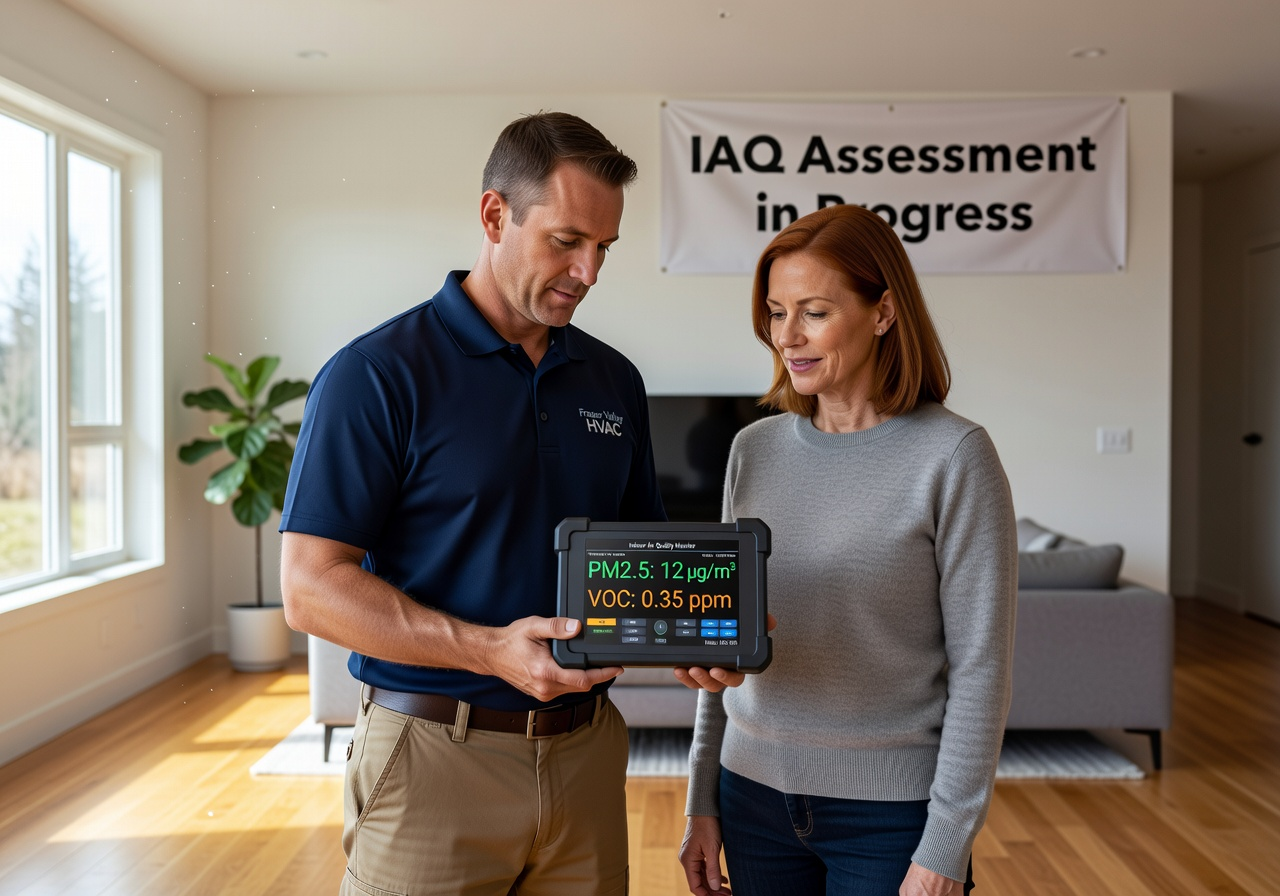
What to Expect from a Professional IAQ Assessment
Before investing in any equipment, a professional IAQ assessment gives you a baseline — so you can target the right solution rather than guessing. A good assessment includes:
- Particulate matter (PM2.5 and PM10) — fine particles from pollen, smoke, and dust
- CO2 concentration — a proxy for ventilation adequacy
- Relative humidity — both too high (>55%, mould risk) and too low (<30%, airway irritation) are problems
- VOC levels — from off-gassing furniture, paint, cleaning products
- Visual mould inspection of the air handler, coils, and ductwork where accessible
- Filter condition assessment and recommendation for appropriate MERV rating
Based on the results, a technician can recommend a prioritized set of upgrades. Many Abbotsford homeowners are surprised to find that a simple filter upgrade and ERV installation provides most of the benefit at a fraction of the cost of a full purification system.
BC Rebates for IAQ Upgrades
Several IAQ improvements qualify for BC CleanBC incentives, particularly when tied to heat pump or ERV installations. The CleanBC Better Homes program offers rebates on ERV/HRV systems and qualifying heat pumps that include enhanced filtration. Your HVAC contractor can confirm current rebate eligibility and help with paperwork.
FAQ: Indoor Air Quality in Abbotsford
How do I know if my home's air quality is poor?
Common signs include persistent allergy or asthma symptoms that worsen indoors, stale or musty odours, visible dust accumulation on surfaces within a day or two of cleaning, condensation on windows, or a CO2 monitor reading above 1,000 ppm regularly. A professional IAQ test removes the guesswork.
Can my existing HVAC system handle a better filter?
Most systems built in the last 15 years can handle a MERV 11–13 filter without issue. Older systems with smaller blower motors may struggle with high-resistance filters — a technician can check your system's static pressure rating before recommending a filter upgrade.
Are portable air purifiers worth buying?
For a single room, a quality portable HEPA purifier (with a CADR rating appropriate for the room size) can be effective. For whole-home coverage, a ducted whole-home solution is more efficient and consistent than multiple portable units.